Friday, September 6, 2013
Sunday, September 1, 2013
Monday, January 28, 2013
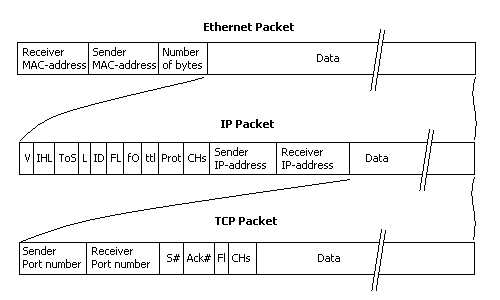
What is the difference between Ethernet, TCP, and IP in simple (simple abstract) terms?
Imagine one of those pneumatic tube
message systems. Ethernet is the tube used to send the message, IP is
an envelope in the tube, and TCP/UDP is a letter in the envelope.
Someone (an application) writes a letter and stuffs it in an envelope. Another person (a NIC) looks at the address on the envelope, puts it in a tube, caps it off, stuffs it in the right door to bring it closer to its destination, then pushes the button.
The tube gets carried to another door, where someone (a router) opens the tube, reads the address, puts it back in the tube, and sends it through another door.
Eventually it arrives at its destination, where the NIC on the other side picks it up and gives it to the application.
This is, of course, a vast oversimplification of what actually happens, but it is a fairly decent base on which to start.
Reference : http://superuser.com/questions/206431/ethernet-vs-tcp-vs-ip
Someone (an application) writes a letter and stuffs it in an envelope. Another person (a NIC) looks at the address on the envelope, puts it in a tube, caps it off, stuffs it in the right door to bring it closer to its destination, then pushes the button.
The tube gets carried to another door, where someone (a router) opens the tube, reads the address, puts it back in the tube, and sends it through another door.
Eventually it arrives at its destination, where the NIC on the other side picks it up and gives it to the application.
This is, of course, a vast oversimplification of what actually happens, but it is a fairly decent base on which to start.
Reference : http://superuser.com/questions/206431/ethernet-vs-tcp-vs-ip
Thursday, December 6, 2012
Decibel scale
Reference : https://ccrma.stanford.edu/~jos/st/Properties_DB_Scales.html
https://ccrma.stanford.edu/~jos/st/Decibels.html
A decibel (abbreviated dB) is defined as one tenth of a bel.
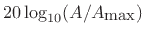
The choice of reference intensity (or power) defines the particular choice of dB scale. Signal intensity, power, and energy are always proportional to the square of the signal amplitude. Thus, we can always translate these energy-related measures into squared amplitude:
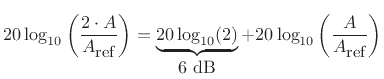
Similarly, a factor of 2 in amplitude gain corresponds
to a 6 dB boost:
and
dB
dB
https://ccrma.stanford.edu/~jos/st/Decibels.html
A decibel (abbreviated dB) is defined as one tenth of a bel.
The bel is an amplitude unit
defined for sound as the log (base 10) of the intensity
relative to some reference intensity,
i.e.,
The choice of reference intensity (or power) defines the particular choice of dB scale. Signal intensity, power, and energy are always proportional to the square of the signal amplitude. Thus, we can always translate these energy-related measures into squared amplitude:
Since there are 10 decibels to a bel, we also have
In every kind of dB, a factor of 10 in amplitude increase corresponds
to a 20 dB boost (increase by 20 dB):
A function
which is
proportional to
is said to ``fall off'' (or ``roll off'') at the
rate of
dB per decade. That is, for every factor of
in
(every ``decade''), the amplitude drops
dB.
A function
which is proportional to
is said to fall off
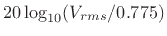
dB per octave. That is, for every factor of
in
(every ``octave''), the amplitude drops close to
dB. Thus, 6 dB
per octave is the same thing as 20 dB per decade.
dB/Octave & dB/Decade
An Octave is where the frequency halves or doubles (by a factor of 2) i.e. 400Hz to 800 Hz
A Decade is where the frequency increases or decreases by a factor of 10 i.e. 5 Hz to 50 Hz
Slopes can be defined as dB/Octave or dB/Decade
20dB/decade ≈ 6.0205999132796 dB/octave
There are 3.3 octaves in one decade .. in other words
6dB/octave is equivalent to 20 dB/decade
number of decades
A Decade is where the frequency increases or decreases by a factor of 10 i.e. 5 Hz to 50 Hz
Slopes can be defined as dB/Octave or dB/Decade
20dB/decade ≈ 6.0205999132796 dB/octave
There are 3.3 octaves in one decade .. in other words
6dB/octave is equivalent to 20 dB/decade
number of decades
Tuesday, December 4, 2012
Finding maximum possible I/O rate on a disk
You can compute the maximum possible sequential I/O rate. It's easy: Look at how many blocks are in one track and how long it takes the disk to make one revolution (at 7200 RPM) then you will know how many bits per second fly under the read/write head. This places an upper bound on the sustained I/O rate.
Generally the XFS file systems gives fastest result.
To make faster read operations, make a separate partition on your drive, possibly at the beginning of the drive (as the beginning of the drive is faster)
Zero copy mechanism
"Zero-copy" describes computer operations in which the CPU does not perform the task of copying data from one memory area to another saving significant processing power and memory. It also saves the time consuming mode switches between user space and kernel space.
Zero-copy protocols are especially important for high-speed networks in which the capacity of a network link approaches or exceeds the CPU's processing capacity. In such a case the CPU spends nearly all of its time copying transferred data, and thus becomes a bottleneck which limits the communication rate to below the link's capacity.
Techniques for creating zero-copy software include the use of DMA-based copying and memory-mapping through an MMU.
Several operating systems support zero-copying of files through specific APIs foe example Windows.
Linux supports zero copy through system calls such as sys/socket.h's sendfile, sendfile64, and splice.
The information above has been taken from Wikipedia.
Zero-copy protocols are especially important for high-speed networks in which the capacity of a network link approaches or exceeds the CPU's processing capacity. In such a case the CPU spends nearly all of its time copying transferred data, and thus becomes a bottleneck which limits the communication rate to below the link's capacity.
Techniques for creating zero-copy software include the use of DMA-based copying and memory-mapping through an MMU.
Several operating systems support zero-copying of files through specific APIs foe example Windows.
Linux supports zero copy through system calls such as sys/socket.h's sendfile, sendfile64, and splice.
The information above has been taken from Wikipedia.
Subscribe to:
Posts (Atom)